Agonist and Antagonist
What are Receptors
Most receptors are protein molecules found over cells. These receptors are responsible for biological activities.
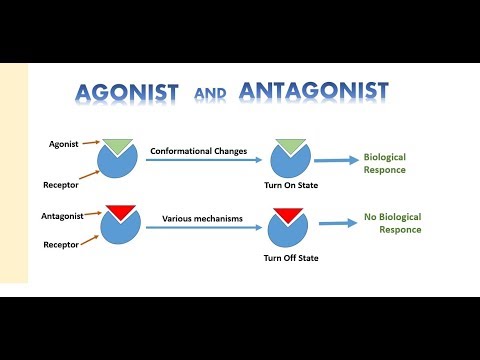
When any signalling molecules (ligand Molecules) binds with these receptors, the receptors, they produces some conformational changes in receptors. These changes turns any receptor in “TURN ON” or “TURN OFF” condition. These conditions are responsible for progression or suppression of any biological process. These ligands can be exogenous (drug / Chemical) or endogenous (biological molecules or hormones).
Agonist
Agonists are the biomolecules or the drug that activate receptors for their biological functions or responses.
An agonist are the exogenous chemicals or the drugs that mimic or show similar effect of endogenous ligands (natural biomolecules). These agonists are resembles the natural signal transmitters or hormones. Drugs as agonist has more clinical values as they can act for longer time as compared to the natural agonists because they have greater capacity to resist their degradation. One example of that is salbutamol (drug) shows longer response than adrenaline / epinephrine (endogenous ligands).Types of Agonists
Agonist are of many types, as:Full Agonist:
When a drug binds to a receptor and produces the similar maximum effect as the endogenous ligand (natural agonist) generates. Then the drug turned as full agonist. The receptors are in active or in inactive state and these states interchanged together reversibly. When a agonist drug binds with inactive receptor, it converts the receptor state from Inactive to active, and also keep the receptor stabilize in this condition. Until the receptor is in active form it shows its biological response.
Partial Agonist:
Partial agonist activate the receptor, but not upto that extent comparable to full agonist. The activation of partial agonist is lesser than the full agonist. Partial agonist reduces the action of full agonists. Partial agonist can occupy or binds with some receptors, so that few or reduced number of receptors become available for binding with full agonist. Due to reduced binding of full agonist to the receptor, biological response gets reduced accordingly. Sometime full agonist generates overstimulation partial agonist use to reduce over response generated by agonists.
Inverse Agonist:
Some substances produces effects, that are specifically opposite of the agonist action. Example benzodiazepines .

Antagonist
Antagonists are the drugs that inhibit, decrease or oppose the action of another drug or endogenous ligands.
Antagonists show their action in the presence of agonists. Antagonists have no effect themselves. Antagonists can bind the same receptor or the other to exert their actions.Types of Antagonists
Competitive Antagonist:
In this type of antagonism, there is competition between agonist and antagonist for binding on the same receptor site. If antagonist binds on the receptor site, it prevents the binding of agonist and keep the receptor in inactive state. Example: terazosin (an anti-hypertensive drug) competes with norepinephrine (an endogenous ligand). They both competes for binding on α1 – adrenoceptors. The binding of agonist or antagonist for competitive antagonism based on law of mass action. The ligand in higher concentration has more ability and probability to bind with receptors.Irreversible Antagonist:
In this type of antagonism, there is no competition between agonist and antagonists, and hence no matter of higher concentration. In this type of antagonism, two mechanism gets involved.-
(a) The antagonist can bind covalently or with vary high affinity to the receptor active site. Due to this strong binding between antagonist and receptor, no sites become available for agonist. And no biological response geberated.
(b) The antagonist binds on the site, other than active site (agonist binding site) or allosteric site. This allosteric antagonism prevents the receptor to become activate, even if the agonist is present on the receptors active site. The antagonism effect cannot be removed even by increasing the concentration of agonists.